
Transforming Behavioral Health. Expanding Access. Strengthening Communities.
At Care Plus NJ, Inc., our Certified Community Behavioral Health Clinic (CCBHC) model represents a modern, accountable, measurable, and community-driven approach to care. We meet individuals and families where they are — delivering integrated, high-quality behavioral health, substance use, and primary care services when and where they are needed most. It is transforming the landscape of care across New Jersey.
A family member's story.

I am so appreciative to the Care Plus program for all the insight, compassion, and behavioral information it has provided me through a very difficult time for me and my family. Care Plus NJ has been extremely helpful in providing me with the necessary tools to better understand and deal with a family member with a substance abuse problem. If it wasn’t for the family counseling offered by Care Plus NJ, I would be in a more difficult position in dealing and coping with this family crisis.
After months in one-on-one counseling, I am now taking part in a weekly support group. It has been helpful to discuss and get feedback from people who are experiencing similar issues to me. As a family member who is attempting to do everything I can to have a better relationship with my son, I find that being provided with guidance and support makes it much easier than doing it alone.
These programs are essential in assisting families through the healing process. It is crucial that these programs continue to exist — because addictions affect the entire family, not only those struggling with addiction. Family involvement is necessary, and continued services are truly favorable.
— Anonymous Client
The Framework
Six pillars of a CCBHC
CCBHCs are structured to address longstanding gaps in the behavioral health system — fragmented care, limited access, inconsistent quality, and poor coordination across providers. Together, the pillars create a standardized framework that ensures every CCBHC delivers comprehensive, timely, and accountable care, regardless of location.
Each pillar targets a critical system need: expanding access when it is needed most, integrating services across behavioral health, substance use, and primary care, and grounding treatment in evidence-based practices that improve outcomes. By structuring care around these six pillars, Care Plus NJ moves beyond a reactive system to one that is proactive, coordinated, and designed to deliver measurable, lasting impact.
01
Staffing
A mixed staffing model built around community needs.
02
Accessibility
Open Access — help on the day it’s identified and needed.
03
Care Coordination
One unified plan across providers, agencies, and systems.
04
CCBHC Core Services
Comprehensive framework of nine services, one whole-person system.
05
Outcome
Outcomes and performance metrics, at the center of every service.
06
Community
Strong governance, community voice, accountable care.
01
Staffing
A Community Needs Assessment serves as a road map to Care Plus NJ’s CCBHC, identifying current conditions and shaping the services our community needs most. Guided by this data and input from key community stakeholders, we have developed a robust staffing model to ensure access to qualified, compassionate professionals.
Oversight is provided by our CEO, Chief Medical Officer, and Project Director, ensuring continuous alignment with CCBHC certification standards. We feature a mixed staffing model — including masters-level clinicians, medical providers, peer specialists, care coordinators, case managers, and more — to ensure the community receives the right care at the right time.
Evidence Based Practices
Having the right staffing includes individuals who are trained in evidence-based models of care. Care Plus NJ is committed to delivering outcome-driven care that reflects the highest standards of behavioral health treatment. Through structured implementation and ongoing fidelity monitoring, we utilize evidence-based practices to ensure consistent, high-quality care.
Several evidence-based practices include:
Our approach integrates clinical expertise with data-informed decision-making, allowing us to continuously improve outcomes, enhance engagement, and ensure that every service delivered aligns with proven models of care.
Cultural Competence
Cultural competence is foundational to service delivery. We provide linguistically optimized services for every community without barriers. Staff are trained in:
This commitment ensures that every individual is treated with dignity, respect, and understanding.
02
Accessibility
Open Access Model
Commonly referred to as Same Day Access, or Walk-In Center, Open Access offers the community a behavioral health assessment on the day that help is identified and needed. Our walk-in center offers immediate access to treatment for adults, children, and families facing worsening behavioral health and addiction related symptoms. Our compassionate team is here to guide you on your path to healing, providing timely care and a supportive environment where hope begins the moment you walk through our doors. Unlike an Emergency Room, nobody waits more than an hour to be helped.
We are conveniently located across northern New Jersey covering multiple counties, with some of our main sites being located in Bergen, Essex, and Morris counties. If you are unable to attend a session in person, we also offer telehealth options.
Social Determinants of Health
CCBHCs recognize that health outcomes are shaped by more than clinical care alone. Through a whole-person approach, Care Plus NJ, Inc. addresses social determinants of health (SDOH) such as housing instability, food insecurity, transportation barriers, and access to benefits. By integrating care coordination and community partnerships into service delivery, we connect individuals to essential supports that stabilize their lives and remove barriers to treatment. This approach not only improves access and engagement, but also leads to more sustainable, long-term health outcomes for individuals, families, and the broader community.
03
Care Coordination
Care Coordination is the process of organizing and connecting all aspects of a person’s care to ensure services are seamless, effective, and centered around their needs. At Care Plus NJ, Inc., care coordination brings together behavioral health, substance use treatment, primary care, and community supports into one unified plan. This includes collaboration with providers, schools, hospitals, and social service agencies to ensure no gaps in care.
This approach is critical because navigating the healthcare system can be complex and overwhelming. Care coordination reduces fragmentation, prevents duplication of services, and ensures individuals receive the right care at the right time. By guiding individuals through their care journey and addressing both clinical and social needs, care coordination leads to better outcomes, stronger engagement, and a more supportive path to recovery and wellness.
04
CCBHC Core Services
The nine core services of the CCBHC model were intentionally selected to reflect the full range of care individuals need to achieve stability, recovery, and wellness. Rather than treating behavioral health, substance use, physical health, and supportive services as separate systems, these nine services create a comprehensive framework that addresses the whole person. Together, they ensure that care is accessible, coordinated, and responsive across the continuum, from crisis response and screening to treatment, rehabilitation, case management, and peer and family support. This structure helps CCBHCs close gaps in care, improve outcomes, and provide communities with a stronger, more integrated behavioral health system.
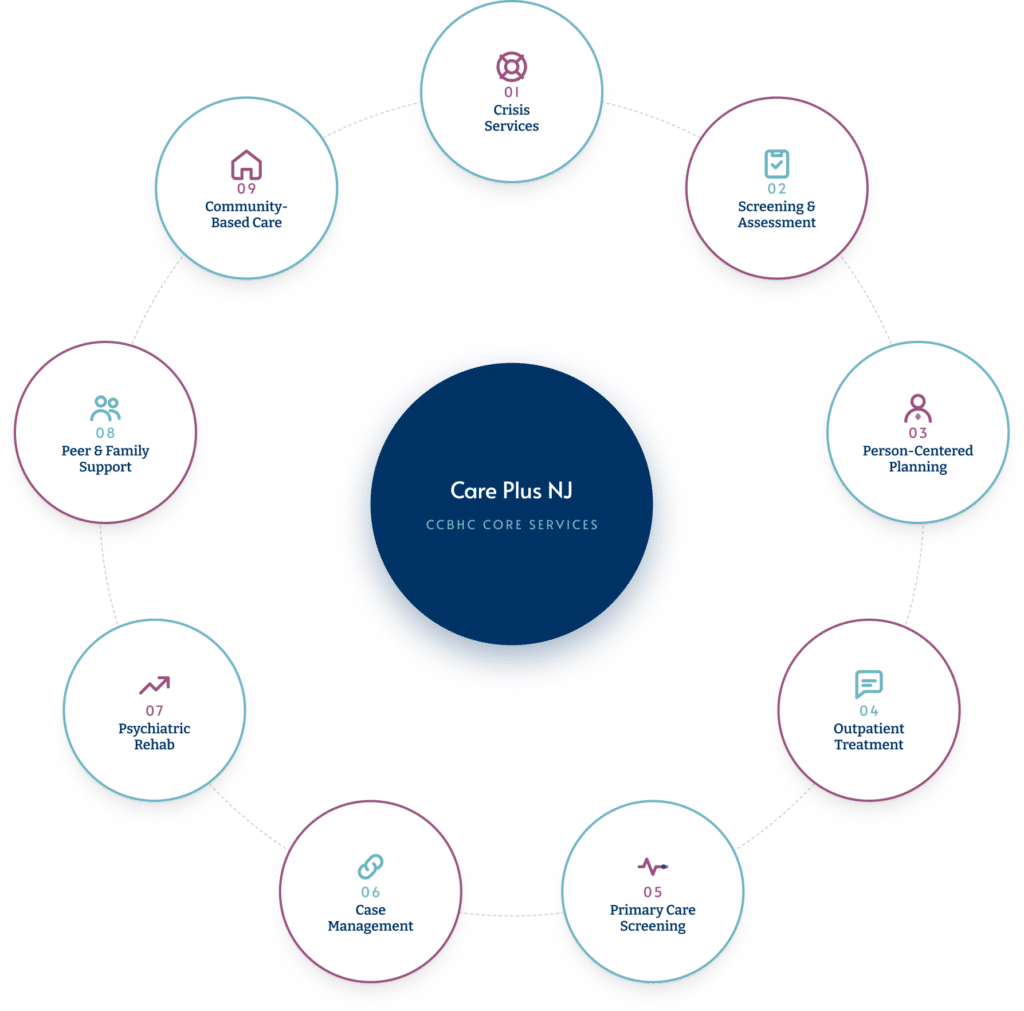
01 · Crisis Services
24/7 Crisis Response
CCBHCs provide round-the-clock response to individuals experiencing urgent behavioral health or substance use needs. Services include mobile crisis teams, stabilization, and coordination with emergency systems — de-escalating situations quickly and connecting individuals to ongoing care.
02 · Screening & Assessment
Screening, Assessment, and Diagnosis
Early identification is critical to effective treatment. Comprehensive screenings and assessments evaluate behavioral health, substance use, and physical health needs — ensuring accurate diagnoses and informing personalized care plans.
03 · Person-Centered
Person-Centered Treatment Planning
Care is guided by individualized treatment plans developed in partnership with each person served. Plans reflect personal goals, preferences, and clinical needs — empowering individuals to take an active role in their recovery.
04 · Outpatient
Outpatient Behavioral Health and Substance Use Services
A full range of outpatient services, including individual, group, and family therapy. Treatment addresses both behavioral health and substance use conditions in an integrated manner — promoting stability, recovery, and long-term wellness.
05 · Primary Care
Primary Care Screening & Monitoring
Physical health is closely connected to behavioral health. CCBHCs provide routine screenings for diabetes, hypertension, and other chronic illnesses, with ongoing monitoring and coordination with primary care providers.
06 · Case Management
Case Management
Case management ensures individuals have access to the resources and services they need. Care managers help coordinate appointments, connect individuals to community supports, and navigate complex systems — reducing barriers and promoting continuity.
07 · Psychiatric Rehab
Psychiatric Rehabilitation Services
These services focus on building skills that support independent living, employment, and community integration. Individuals receive support in developing daily living, social, and coping skills to enhance functioning and quality of life.
08 · Peer & Family
Peer and Family Support Services
Support from individuals with lived experience plays a vital role in recovery. Peer specialists and family support providers offer guidance, education, and encouragement — strengthening engagement and providing connection and understanding.
09 · Community-Based
Intensive, Community-Based Care
For individuals with more complex needs, services are delivered directly in the community — including homes, schools, and other settings. This approach reduces hospitalizations and keeps individuals connected to their natural supports.
05
Outcome
Outcomes and performance metrics are central to the CCBHC model, ensuring that care is not only accessible, but also effective and accountable. Through a combination of clinic-level and state-defined measures, Care Plus NJ, Inc. continuously evaluates the quality, timeliness, and impact of services delivered. These metrics provide a clear picture of how individuals are progressing, where improvements are needed, and how resources can be best utilized. By grounding care in data and measurable outcomes, CCBHCs drive continuous quality improvement, strengthen transparency, and ensure that services deliver meaningful, lasting results for individuals and communities.
Facts & Figures
CCBHCs are making a difference: Ensuring Excellence in Mental Health Act ensures they’ll be able to continue doing so.
Today, more than 500 CCBHCs across 48 states and territories (covering 40% of all U.S. counties) serve an estimated 3 million people nationwide. Key findings from across the U.S. include:
500
CCBHCs operating across 48 states and territories, covering 40% of U.S. counties and serving roughly 3M people.
33
Increase in the number of individuals served — improved access reported by CCBHCs nationwide.
60
Of CCBHCs report an increase in individuals engaged in Medication-Assisted Treatment (MAT) for opioid use disorder.
80
Of CCBHCs have expanded programs to reach veterans and people experiencing homelessness.
10
Median time to first routine appointment at a CCBHC, compared to the 48-day national average.
55
Reduction in ER visits and in mental-health hospitalizations among individuals served.
31
Decrease in 30-day homelessness measured among individuals served by CCBHCs.
22
Median number of new positions added per CCBHC clinic through the PPS — strengthening the workforce.
3M
People nationwide currently receiving care through a CCBHC.
06
Community
CCBHCs are accredited to ensure consistent, best-practice services are offered, and are licensed by the state to provide treatment and care. Governance is a foundational pillar of the CCBHC model, ensuring that care is guided by strong leadership, accountability, and community voice. At Care Plus NJ, Inc., governance structures include oversight from executive leadership and a board of directors that reflects the diverse populations we serve, in addition to a CCBHC advisory committee. This framework promotes transparency, ethical decision-making, and continuous alignment with community needs and CCBHC standards. By incorporating stakeholder input, including individuals with lived experience, governance ensures that services remain responsive, effective, and grounded in the realities of those we serve.